The quick answer: An electric oven that trips the power usually has a heating element leaking current, either from moisture soaked into it or a crack. That trips the safety switch. If the circuit breaker drops instead, suspect a short circuit or a burnt connection. Switch the oven’s circuit off and get it tested before using it again.
Ovens pull a lot of current for long stretches at high temperature, and the parts carrying it wear out. Here’s how to work out what’s failed, and which part of the job belongs to a licensed electrician.
Is it the safety switch or the circuit breaker that’s tripping?
Head to the switchboard and look at what has dropped to the off position. This one detail tells you a lot.
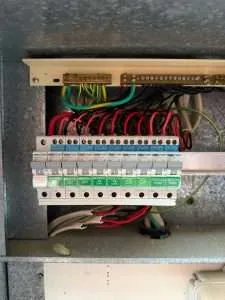
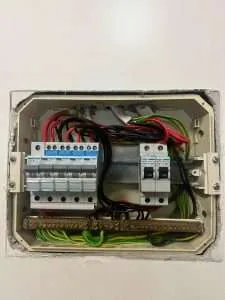
- The safety switch (RCD) has tripped. It’s the device with a test button and “30mA” on the front. It trips when current leaks to earth, so the likely cause is a leaking element or moisture somewhere in the oven or its wiring.
- The circuit breaker labelled “Oven”, “Range” or “Cooker” has tripped. Breakers react to too much current. That points to a short circuit inside the oven, a failed element shorting out, or a damaged connection.
- Both have tripped, or the main switch has gone. Treat that as a serious fault and leave the oven off.
In older Melbourne homes the oven circuit may not be on a safety switch at all. RCD protection on hard-wired cooking circuits only became standard in newer installations under the AS/NZS 3000 Wiring Rules. If your board has no safety switch covering the oven, a leaking element may not trip anything until it fails completely, which is a good reason to have it checked.

Why does my oven trip the power the first time I use it in a while?
This is the most common oven call we get, and the cause is usually moisture in the element.
Oven elements are a metal tube with a coiled wire inside, packed in a mineral powder (magnesium oxide) that insulates the wire from the tube. That powder draws in moisture from the air through the ends of the element. Regular cooking keeps it dry. Leave the oven unused for a few weeks, over a holiday or while a kitchen is being renovated, and the powder can absorb enough moisture to leak current to the metal casing. The safety switch sees that leakage and trips.
Steam and combination ovens are especially prone to this. Miele’s Australian support page notes it can happen when the oven function is used much less often than the steam function, because the elements never dry out properly.
Sometimes an element that tripped once will dry out and behave. But if it trips again, or it trips every time you start the oven, the element has likely been damaged by repeated moisture and needs replacing. Don’t keep resetting it hoping it will dry.
Why does it trip after the oven has been on for a while?
If the oven runs for 10 or 20 minutes before tripping, heat is involved. Elements expand as they warm, and a hairline crack can open up and let the coil short to the tube. Look for a blister, bulge or bright spot on the element.
Other heat-related causes:
- The fan motor in a fan-forced oven can develop a winding fault that only shows up when it’s warm
- Connection terminals at the back of the oven can loosen and overheat after years of heating and cooling
- Cable behind a wall oven can be cooked by poor ventilation in the cabinetry
If you notice a burning smell that isn’t food, or the trip comes with a pop or a flash, stop using the oven.
Why does it only trip on grill, bake or fan-forced?
Ovens use different elements for different functions: a top element for grilling, a bottom element for conventional baking, and a ring element around the fan for fan-forced. If the oven trips on one setting and not another, you’ve almost certainly identified the faulty element. Make a note of which function causes the trip. It speeds up the repair, because the technician can bring the right part.
Does a pyrolytic (self-clean) cycle cause tripping?
It can. Pyrolytic cleaning runs the oven far hotter than normal cooking for a couple of hours, which stresses the elements and wiring connections. A marginal element often fails during or just after a self-clean. If tripping started right after a clean, mention it when you book.
Can the cooktop make the oven circuit trip?
Yes, if they share a circuit, which is the case with freestanding upright cookers and many wall oven and cooktop pairs. A pot boiling over onto a ceramic cooktop, a cracked glass top or a failed hotplate can trip the same circuit. Notice whether the trip happens with the cooktop, the oven, or both.
Could it be my wiring rather than the oven?
It’s less common, but we see these regularly:
- A new oven on an old circuit. Larger ovens and double ovens draw more current than the 60cm oven they replaced. If the circuit, cable or breaker wasn’t upgraded, it can overload.
- A plug-in oven on a shared power point. Some smaller wall ovens plug into a standard 10 amp power point. If that point is on a circuit shared with the dishwasher or microwave, the breaker can trip under combined load.
- The oven isolator switch near the oven has failed or has a loose terminal.
- Rodents in the cabinetry or ceiling have damaged the oven cable.
Anything involving the circuit, cable, isolator or connection to the oven is fixed wiring. In Victoria that must be done by a licensed electrician, and Energy Safe Victoria says plainly that unqualified electrical work is illegal.
What you can safely check before calling
Keep it to these steps. Don’t pull the oven out of its cabinet, remove its back panel, or open the switchboard cover.
- Turn the oven off at its controls and at the oven isolator switch if you have one (usually a wall switch labelled “Oven” near the kitchen).
- Check the switchboard to see whether the safety switch, the oven breaker, or both have tripped.
- Turn the oven breaker off, then reset the safety switch. The rest of the house on that safety switch should come back on.
- If you want to confirm the oven is the cause, turn the oven breaker back on with the oven still off at its controls. If the safety switch trips immediately with the oven not running, the fault is in the wiring or a fault at the oven’s connection, and you should call an electrician.
- If it holds, try one oven function only (for example, bake). If it trips, note which function and stop. Don’t cycle through every setting repeatedly.
- Leave the oven breaker off until it’s been repaired, so the rest of your power stays on.
- Check your warranty. If the oven is only a few years old, the manufacturer may cover a failed element.
Don’t wait until morning if:
Who should fix it: an electrician or an appliance technician?
A failed element or fan motor inside the oven is appliance repair. The cable, isolator, breaker, safety switch and oven connection are fixed electrical work for a licensed electrician. Our oven installation and repair service covers both: we test the circuit first to rule out the wiring, then fix whichever part has failed.
Still tripping with the oven circuit off? The fault is elsewhere, and our guide to a safety switch tripping with nothing plugged in shows how to find it. If the kettle is the trigger, see kettle tripping the power.
Once power is back, press the test button on each safety switch (how to test an RCD). If the oven breaker itself seems worn, read can electrical breakers go bad or see our circuit breaker installation and repair service.

Frequently asked questions
Is it safe to use an oven that tripped the power once?
If it was a single trip after a long break and the oven has worked normally since, moisture in the element is the likely cause and it may have dried out. If it trips a second time, stop using it and have the element and circuit tested.
Can I dry out a wet oven element myself?
Running the oven regularly is the best way to keep elements dry, and some manufacturers suggest leaving the door ajar at first to let moisture escape. If the element is already tripping the safety switch, though, it needs testing. An element that has absorbed enough moisture to trip once often keeps failing.
Why does my oven trip the power but the cooktop works fine?
The oven and cooktop may be on separate circuits, or the fault may be in an oven element or fan motor that the cooktop doesn’t use. Note which oven function causes the trip so the technician knows which element to test.
Do ovens need to be on a safety switch?
Under the current AS/NZS 3000 Wiring Rules, new domestic installations need RCD protection on final subcircuits, including hard-wired cooking appliances. Older homes may not have it. An electrician can tell you whether your oven circuit is protected.
Is a tripping oven an emergency?
A trip on its own means the protection did its job. It becomes urgent when there’s a burning smell, scorching, a shock, smoke, or a switch that won’t reset. In those cases, leave the oven circuit off and call a 24/7 electrician.

Oven still tripping? Talk to a Melbourne electrician
If your oven keeps knocking out the power, Electrical Powerhaus can test the circuit, the element and the safety switch and tell you exactly what’s failed. We’re based in Box Hill and work right across Melbourne, with an emergency service that runs 24/7 for burning smells, scorching and switches that won’t reset. Call 03 6358 2028 or visit our 24/7 emergency electrician page.
If it’s your first time booking with us, we take 15% off that first service. Pensioners and seniors always get 10% off, whichever job it is.